
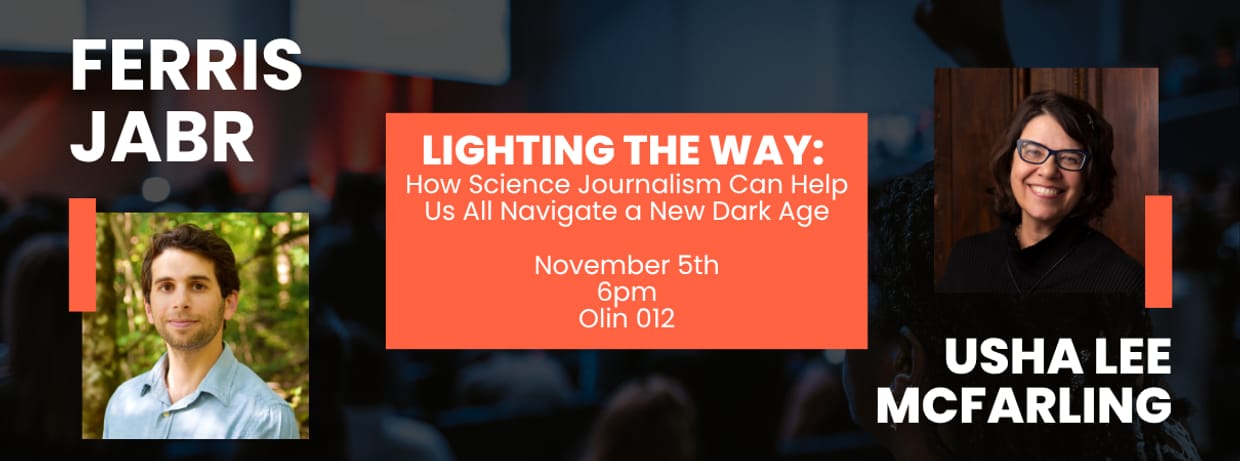
Lighting the Way: How Science Journalism Can Help Us All Navigate a New Dark Age
Science journalism is an especially challenging form of nonfiction. It requires journalists to translate and synthesize large volumes of technical information, explain highly complex ideas to the general public, and craft compelling narratives. A science journalist’s job depends on a finely honed ability to interview and debate relevant experts; distinguish between credible sources of information and unreliable ones; and separate the facts from biases, prejudice, and personal agendas. Rigorous research and fact-checking are not enough, however. The most successful science journalism understands how to reach and engage readers through the power of story. In this time of upheaval and uncertainty, attacks on science and academia, AI forgery and widespread misinformation, such skills have never been more important — not only for journalists, but for every member of our democracy. In many ways, this is a new dark age, one in which vital knowledge is withheld, concealed, distorted, and erased. But science journalism offers a guiding light. In this panel, Usha Lee McFarling, Pulitzer Prize winner and Director of the Knight Science Journalism Program at MIT, and Ferris Jabr, NYT bestselling author and contributing writer for The New York Times Magazine, will discuss the role of science journalists in the current information ecosystem and explore how everyone can apply the lessons they have learned from their profession to their own lives and careers.
Bios:
Ferris Jabr (Tufts class of 2009) is the New York Times bestselling author of Becoming Earth and a contributing writer for The New York Times Magazine. Reviewers have described Becoming Earth as an “electrifying” and “infectiously poetic” “masterwork” that “earns its place alongside the best of today’s essential popular science books, as well as acknowledged classics.”
Ferris has also written for The New Yorker, The Atlantic, Harper’s, National Geographic, and Scientific American, among numerous other publications. He has received fellowships from Yale, MIT, and UC Berkeley, as well as grants from the Pulitzer Center and the Whiting Foundation. His work has been anthologized in four editions of The Best American Science and Nature Writing series.
Ferris has an MA in journalism from New York University and a Bachelor of Science from Tufts University. He lives in Portland, Oregon, with his partner, Ryan, and more plants than they can count. His surname rhymes with neighbor.
Usha Lee McFarling is the director of the Knight Science Journalism Fellowship Program at MIT and a veteran science journalist who has reported for STAT, the Los Angeles Times, the Boston Globe, the Knight Ridder Washington Bureau, and the San Antonio Light. Her work has received a Pulitzer Prize for explanatory journalism, Polk Award, Victor Cohn prize for excellence in medical science reporting, Edward R. Murrow award and the Bernard Lo, MD award in bioethics, among others. She currently serves on the board of the Association of Health Care Journalists and is publisher of Undark. Usha graduated from Brown University with a degree in biology and earned a master's degree at UC Berkeley. Her first name rhymes with fuchsia.
Date

Tufts University - Office for Campus Life
In supporting the mission of Tufts University, the School of Arts, Sciences, and Engineering, and Student Life, the Office for Campus Life aims to strike a balance between curricular and co-curricular opportunities for all students.
Need assistance? Email us at ocl@tufts.edu or give us a call at 617-627-3212.